
(Introduction)
Humans have always had a desire to understand the mysteries of the sky. This quest has inspired us to go beyond the boundaries of Earth and send space missions. Space missions are projects through which humans or robotic machines are sent into space to conduct scientific research, study planets, and gain new knowledge about Earth.
Space missions are not limited to scientific research, but are also important sources of advancement in technology, education, and human life. The United States, Russia, China, and European countries have not only sent missions into orbit, but also sent research missions to Mars, the Moon, and other planets.
This article will provide you with detailed information about the types of space missions, history, major missions, benefits, challenges, and future plans so that you have a complete understanding of this field.
Types of space missions
Space missions are carried out for various purposes and methods. They are generally divided into four main types:
Human space missions
Human space missions involve sending humans into space to conduct research, conduct experiments, or monitor other missions. The most famous human mission was the Apollo program, which brought humans to the Moon for the first time. Human missions not only provide scientific information but also help to understand the possibilities of long-term human survival in space.
Robotic or unmanned missions
These missions are unmanned and mostly involve sending robotic instruments or satellites into space. For example, Mars rovers, Voyager spacecraft, and robots sent to the Moon. These missions are useful for research in dangerous and remote areas, where sending humans would be expensive or difficult.
Research and scientific missions
These missions are primarily for scientific research. They send various instruments into space to study stars, planets, the space environment, and Earth. The Hubble Space Telescope is an example of this, which has provided us with information about the distant stars and galaxies in the universe.
Defense and satellite missions
These missions are carried out for Earth communication, navigation, meteorology, and defense purposes. Satellites have made communication, weather forecasting, and Earth observation possible around the world.
History of space missions
The history of space missions spans nearly 60 years and is a magnificent tale of human knowledge and exploration. Man has always had a desire to explore the vastness of the sky, but the journey to turn this desire into reality began in the 20th century.
Early era: Sputnik and Vostok
Space missions began during the Cold War, when the United States and Russia began a race to be the first to set foot in space. In 1957, Russia launched Sputnik 1, the first artificial satellite of the Earth. It was a historic moment for the world because man had put an artificial body into orbit outside his own Earth.A few years later, in 1961, Russian cosmonaut Yuri Gagarin became the first human to perform a spaceflight, orbiting Earth aboard Vostok.
The Apollo Program and Missions to the Moon
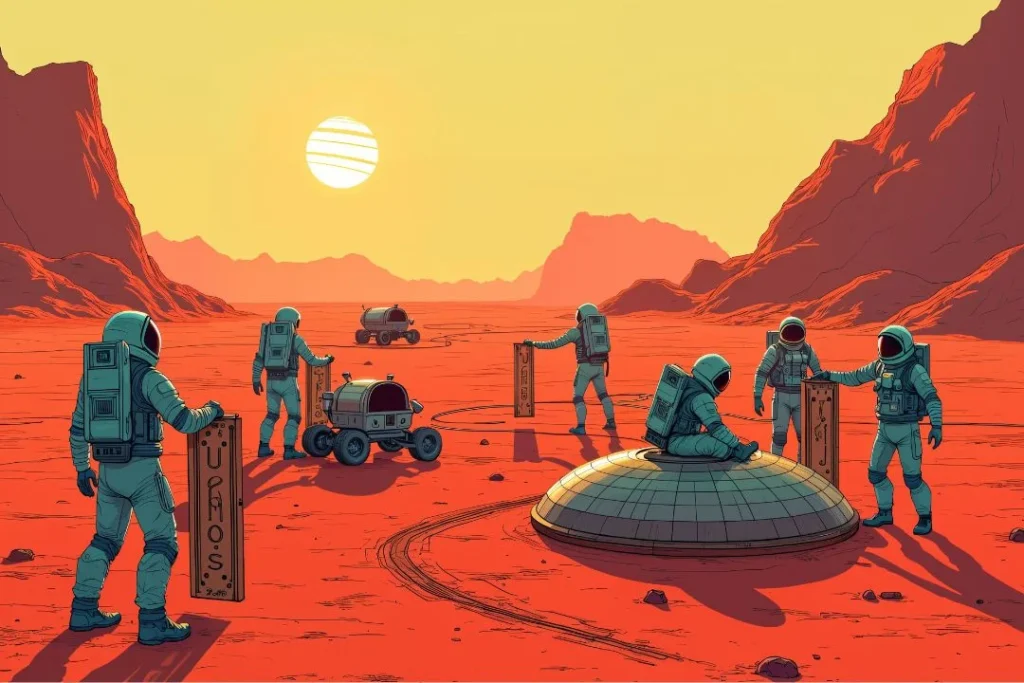
The United States launched the Apollo program in the 1960s. The program’s greatest achievement was the first human landing on the moon in 1969 with Apollo 11. Neil Armstrong and Buzz Aldrin set foot on the lunar surface, and the event became an unforgettable moment in human history.Through the Apollo program, we gained knowledge not only about the lunar surface but also about the effects of long-term space flight on the human body.
Exploration of Mars and other planets
After the 1970s, the focus of space missions shifted beyond Earth’s orbit to other planets and asteroids. The United States and Russia sent exploration missions to Mars, Saturn, and Jupiter. The Mariner program provided basic information about Mars. Later, the Voyager missions provided incredible information about distant galaxies and planets.
Modern era: international cooperation and private companies
The scope of space missions has expanded in the 21st century. The International Space Station (ISS) is a prime example, where astronauts from different countries conduct joint research. In addition, private companies, such as SpaceX and Blue Origin, have made space travel more affordable and feasible. Rovers are being sent to Mars, and plans are being made for a future human settlement there.
Important space missions
Many missions have made history in space exploration. These missions not only provide scientific information but are also great examples of human courage and technological advancement.
The Apollo program
The Apollo program is the most famous program of the United States NASA. Its goal was to send humans to the moon and conduct research there. In 1969, Neil Armstrong and Buzz Aldrin set foot on the lunar surface for the first time through the Apollo 11 mission. This mission opened new horizons for humanity and paved the way for space exploration.Subsequent Apollo missions brought back samples of the lunar surface, soil, and rocks, which remain important research tools for scientists today.
Mars Missions
Various countries have sent several missions to explore Mars. Among them, Mars rovers such as Spirit, Opportunity, Curiosity, and Perseverance are the most important. These robotic missions collect information about the surface of Mars, its atmosphere, the presence of water, and possible life. The recent missions are part of the preparation for sending humans to Mars and plans to colonize it in the future.
International Space Station (ISS)
The International Space Station is a joint venture involving the United States, Russia, European countries, Japan, and Canada. The ISS is in orbit and hosts various scientific experiments that are useful for human life on Earth. The station has helped to better understand the possibilities of long-term human presence in space.
Advanced research missions
The Hubble Space Telescope and other advanced robotic missions have provided important information about distant galaxies, stars, and planets. These missions provide the opportunity to study the depths of the universe beyond Earth in space, expanding human knowledge.
Missions of private companies
Recently, private companies such as SpaceX, Blue Origin, and Virgin Galactic have been active in space missions. These companies are using modern technology to transport people and goods into space, making space travel more affordable and possible. In the future, these companies will be part of projects to explore and colonize Mars and other planets.
Frequently Asked Questions (FAQs) about space missions
What are space missions?
Space missions are programs or activities that send humans or robotic devices into space so that we can study planets, stars, and other celestial bodies beyond Earth.
What is the difference between human and robotic missions?
Human missions involve astronauts going into space themselves and conducting experiments, such as the Apollo program. Robotic missions involve sending only robots or space instruments, which are used to explore remote or dangerous locations, such as Mars rovers.
When did space missions begin?
Space missions began in 1957, when Russia sent Sputnik 1, Earth’s first artificial satellite, into orbit. In 1961, Yuri Gagarin became the first human to orbit the Earth.
Why is the Apollo program important?
The Apollo program landed humans on the Moon for the first time and allowed for research there. It not only provided information about the lunar surface but also demonstrated the capabilities of human space travel.
What are the main objectives of Mars missions?
Mars missions provide information about the Martian surface, atmosphere, presence of water, and possible life on Mars. They provide the basis for future human settlement on Mars.
What is the International Space Station (ISS)?
The ISS is a joint space station in which astronauts from different countries conduct scientific experiments. It is helpful for humans to survive in space for long periods of time and to conduct experiments useful for Earth.
How are private companies participating in space missions?

Companies like SpaceX, Blue Origin, and Virgin Galactic are using advanced technology to send people and cargo into space. These missions help make space travel safer and cheaper.
(Conclusion)
Space missions are a prime example of human knowledge and exploration. They not only provide information about the Earth and the universe, but also create opportunities for advancement in technology and human life.
Human and robotic missions have revealed important facts about the Moon, Mars, and other planets. The International Space Station and missions by private companies have made research and long-term presence in space possible.
Finally, space missions inspire us to understand the mysteries of the universe, protect the Earth, and explore the possibilities for future human settlement.